
Mobile Crane Control Valve Repair: 40 bar Relief Loss Fixed
A six section proportional valve from a mobile crane let the winch drift in neutral and had lost fine control. Varnish in the bores, scratched spools and a set relief spring had dropped relief pressure by 40 bar. ASAT honed the bores, lapped the spools, renewed every seal, reset the reliefs and tested the valve at 280 bar.
01. Project Overview
Operational Context & Requirement
A multi-section proportional directional valve from a mobile crane was sent to ASAT experiencing severe internal cross-port leakage. The operator reported loss of fine metering control on hoist operations, creating safety concerns during high-elevation lifts.
02. Equipment & Component
Component Classification & Technical Parameters
Equipment Class
Mobile Crane Hydraulic System
Component Inspected
Multi-Spool Directional Control Valve Bank
- Valve Configuration
- 6-Section Proportional Directional
- Rated Max Pressure
- 315 bar
- Max Flow Rate
- 250 L/min
- Spool-to-Bore Clearance
- 0.005 – 0.008 mm
- Seal Material
- High-Temperature FKM / PTFE
03. Initial Issue
Observed Fault & Symptoms
Equipment Failure Manifestation
The crane main hoist and boom telescope circuits suffered severe creeping under load, erratic joystick control response, and high oil temperatures indicative of internal leakage between valve spools and casting body.
Winch drift when the valve was in neutral position, accompanied by excessive spool resistance when operating controls under cold oil conditions.
04. Inspection & Diagnosis
Teardown Findings & Root Cause Analysis
Fluid contamination and heat degradation had formed stubborn varnish films inside the precision valve bores.
Two spools displayed fine abrasive scratches on the metering notches, allowing fluid bleed between work ports.
Internal check valve poppets showed minor seat erosion, causing slow load drop.
Main circuit relief valve spring had taken a permanent set, dropping system relief pressure by 40 bar.
05. Repair Methodology
Engineering Overhaul & Precision Machining Work
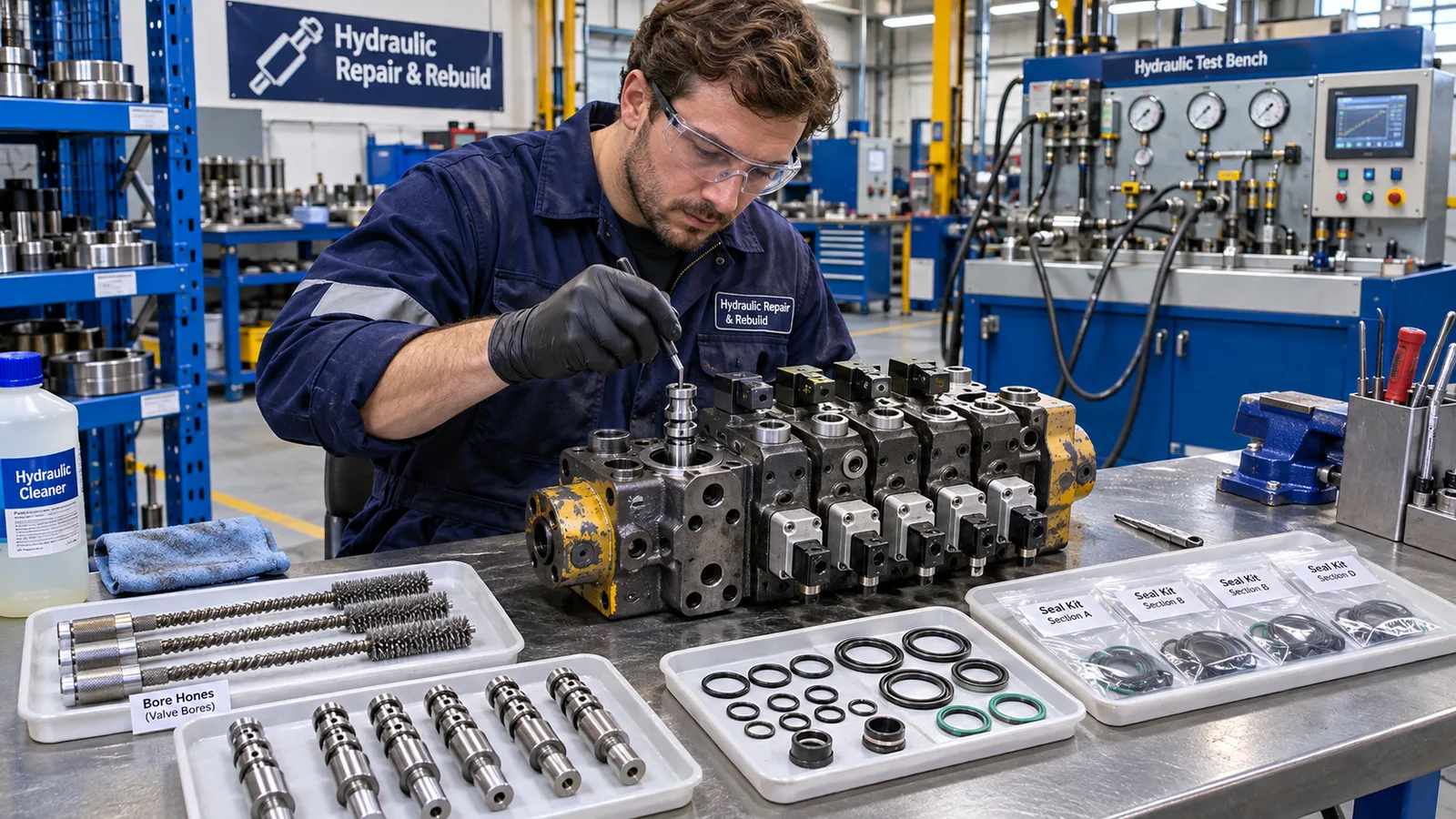
The multi-section valve bank was disassembled section by section. Each spool was micro-measured for clearance against its cast bore. Bores were gently honed with fine abrasive tools to eliminate varnish and micro-galling. Cartridge pilot reliefs were dismantled, reseated, and set to OEM pressure specifications on the test bench.
Detailed Work Execution Scope
- Disassembly of valve sections and individual relief cartridges
- Micro-lapping of valve spools and precision hone deburring of bores
- Complete fluoroelastomer O-ring and backup ring renewal
- Port-by-port pressure and relief valve bench calibration
06. Testing & Verification
Hydrostatic Pressure Benchmark & Quality Assurance
- Pressure testing on ASAT valve test manifold at 280 bar operating pressure.
- Individual section internal leakage checked with flow meters on blocked A and B ports.
- Main and port relief valves set and lock-wired to exact machine manual specifications.
- Electrical solenoid coils and proportional PWM response checked across operating range.
All valve sections exhibited crisp proportional modulation, zero spool binding, and internal holding pressure stability within factory limits under load.
07. Final Outcome
Delivered Performance & Operational Return
A six section proportional valve from a mobile crane let the winch drift in neutral and had lost fine control. Varnish in the bores, scratched spools and a set relief spring had dropped relief pressure by 40 bar. ASAT honed the bores, lapped the spools, renewed every seal, reset the reliefs and tested the valve at 280 bar.