Axial Piston Pump Overhaul: 140 cc/rev Pump Back to Spec
A 140 cc/rev variable displacement axial piston pump was whining, surging and slowing the machine's boom cycles. Teardown found cavitation pitting on the valve plate, worn slipper shoes and damaged cradle bearings. ASAT lapped the valve plate, renewed the rotating group, seals and bearings, then flow tested it from 500 to 1,800 RPM up to 320 bar.
01. Project Overview
Operational Context & Requirement
A variable-displacement axial piston pump used in demanding continuous-duty machinery experienced severe flow loss and hydraulic chatter under high working loads. ASAT engineers received the pump for comprehensive workshop inspection, precision overhaul, and dynamic bench verification.
02. Equipment & Component
Component Classification & Technical Parameters
Equipment Class
Industrial Heavy Equipment
Component Inspected
Axial Piston Main Hydraulic Pump
- Pump Displacement
- 140 cc/rev
- Maximum Pressure
- 350 bar
- Continuous Pressure
- 280 bar
- Drive Speed Range
- 600 – 2,200 RPM
- Shaft Seal Material
- Fluoroelastomer (FKM / Viton)
03. Initial Issue
Observed Fault & Symptoms
Equipment Failure Manifestation
The primary hydraulic pump exhibited noticeable operational whine, surging output pressure, and reduced actuator speeds under peak load. Hydraulic oil analysis indicated elevated bronze particle contamination from internal friction surfaces.
The machine operator reported erratic boom cycle speeds, loss of breakout force under full throttle, and excessive fluid temperature in the return circuit. High-frequency vibration and audible pump whine suggested internal fluid slippage and mechanical wear.
04. Inspection & Diagnosis
Teardown Findings & Root Cause Analysis
Disassembly revealed score tracks and cavitation pitting across the bimetallic valve plate running surface.
Three piston shoes showed slipper face scoring and excessive ball-socket clearance (>0.06mm).
The swashplate cradle bearings displayed brinelling and micro-spalling from sustained shock loading.
Shaft drive splines and mechanical shaft seals were examined for radial play and heat hardening.
05. Repair Methodology
Engineering Overhaul & Precision Machining Work
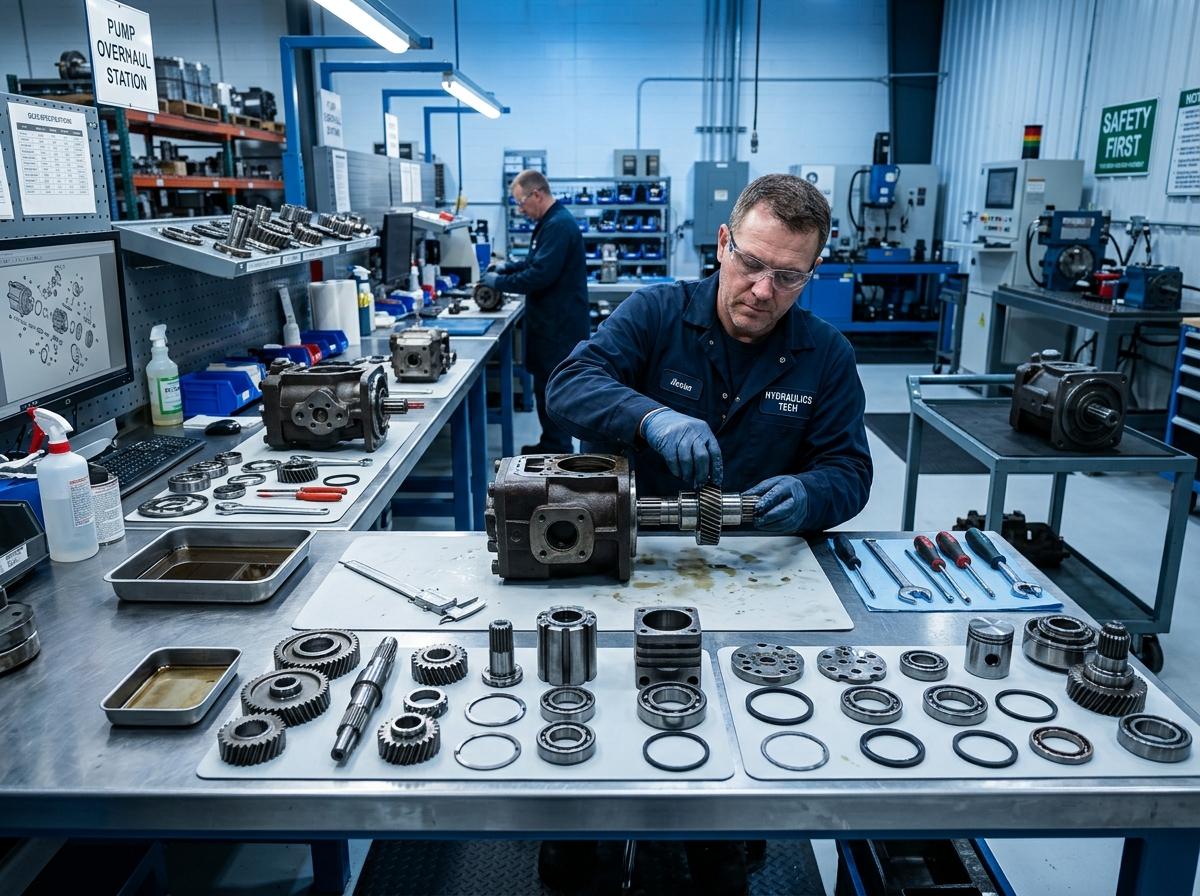
The pump was disassembled into component sub-assemblies. Inspection revealed cavitation erosion on the valve plate and scoring on piston shoe slippers. Technicians precision-lapped the port plate, replaced the worn rotating group with genuine components, renewed shaft seals and heavy-duty bearings, and bench-tested the unit under load.
Detailed Work Execution Scope
- Disassembly and microscopic wear pattern analysis
- Precision lapping of valve plate and swashplate cradle
- Replacement of piston shoes, cylinder barrel, and shaft bearings
- Dynamic flow and pressure calibration on hydraulic test bench
06. Testing & Verification
Hydrostatic Pressure Benchmark & Quality Assurance
- Mounted on workshop test bench with ISO VG 46 fluid at 50°C operating temperature.
- Flow output measured across 500 to 1,800 RPM at incrementing pressure steps up to 320 bar.
- Verification of pressure cut-off and load-sensing compensator stability under rapid load transitions.
- Case drain leakage rate measured and confirmed well within allowable OEM operational thresholds.
Pump flow rate, volumetric efficiency, and compensator responsiveness were verified on the test bench to match manufacturer baseline performance data prior to dispatch.
07. Final Outcome
Delivered Performance & Operational Return
A 140 cc/rev variable displacement axial piston pump was whining, surging and slowing the machine's boom cycles. Teardown found cavitation pitting on the valve plate, worn slipper shoes and damaged cradle bearings. ASAT lapped the valve plate, renewed the rotating group, seals and bearings, then flow tested it from 500 to 1,800 RPM up to 320 bar.